
Jute bags are widely used in India for packaging, storage, shopping, gifting, promotional activities and agricultural applications. With the growing demand for eco-friendly alternatives to plastic bags, jute bags have become an important product for manufacturers, wholesalers, retailers and exporters.
If you are involved in the manufacturing, trading or selling of jute bags, knowing the correct jute bag HSN code is important for GST invoicing, taxation, product classification and business compliance.
The HSN classification for a jute bag depends on the type and intended use of the bag. Jute sacks used for packing goods are generally covered under HSN heading 6305, while certain jute handbags and shopping bags can fall under heading 4202. The exact classification should therefore be determined according to the product’s characteristics and use.
In this guide, we explain the jute bag HSN code, GST rate, different HSN codes for jute bags, classification, and frequently asked questions.
What Is the HSN Code for Jute Bags?
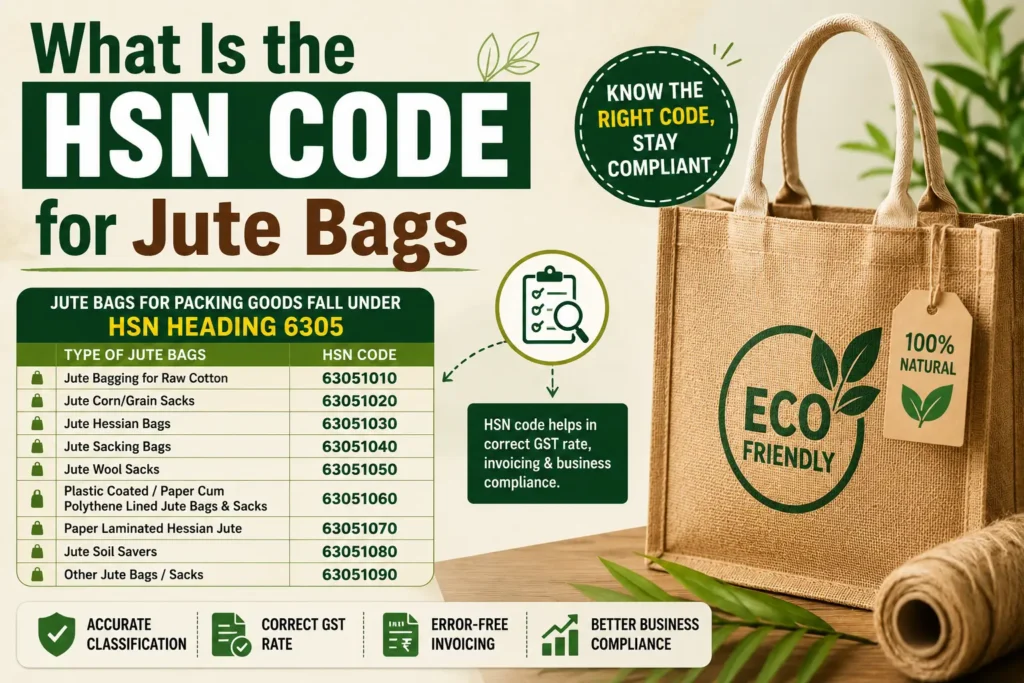
For jute sacks and bags used for packing goods, the relevant HSN heading is 6305.
Under heading 6305, jute or other textile bast-fibre sacks and bags are classified under 630510. More specific tariff codes are used depending on the type of jute bag.
Some commonly used classifications include:
| Jute Bag Product | HSN Code |
|---|---|
| Jute Bagging for Raw Cotton | 63051010 |
| Jute Corn/Grain Sacks | 63051020 |
| Jute Hessian Bags | 63051030 |
| Jute Sacking Bags | 63051040 |
| Jute Wool Sacks | 63051050 |
| Plastic Coated/Paper Cum Polythene Lined Jute Bags & Sacks | 63051060 |
| Paper Laminated Hessian Jute | 63051070 |
| Jute Soil Savers | 63051080 |
| Other Jute Bags/Sacks | 63051090 |
The official tariff classification identifies heading 6305 as covering sacks and bags of a kind used for the packing of goods, with 630510 specifically covering jute and other textile bast fibres of heading 5303.
Jute Bag HSN Code: 6305 Explained
HSN code 6305 is used for sacks and bags that are designed for packing goods.
This heading covers textile sacks and bags commonly used for the transport, storage or sale of goods. Examples include grain sacks, flour sacks, coffee sacks, potato sacks, mail bags and similar packaging bags.
The six-digit classification 630510 relates specifically to bags made from jute or other textile bast fibres covered by heading 5303.
The final two digits provide a more detailed product classification.
For example:
- 63051020 – Jute corn/grain sacks
- 63051030 – Jute hessian bags
- 63051040 – Jute sacking bags
- 63051060 – Plastic-coated or paper-cum-polythene-lined jute bags and sacks
- 63051090 – Other bags and sacks
Therefore, businesses should not automatically use one HSN code for every type of jute bag. The correct code should match the actual product.
GST Rate on Jute Bags
The GST applicable to a jute bag depends on its HSN classification and nature of the product.
This distinction is particularly important because not every product described commercially as a “jute bag” necessarily falls under the same HSN heading.
For example, jute sacks used for packing goods are covered under heading 6305, whereas handbags and shopping bags of jute are specifically classified under heading 4202 22 30 in the GST rate schedule. Current CBIC material lists this jute handbag/shopping-bag entry at 12% GST (6% CGST + 6% SGST).
For this reason, businesses should verify the product description and applicable GST notification before issuing an invoice.
Important GST Classification Difference
There is a significant difference between:
1. Jute packing sacks
These are bags intended primarily for packing, transporting or storing goods and generally fall under HSN heading 6305, subject to the detailed tariff classification.
2. Jute handbags and shopping bags
These may fall under HSN 4202 22 30, which specifically covers handbags and shopping bags of jute. The current CBIC rate schedule shows 12% GST for this category.
Therefore, simply calling a product a “jute bag” is not enough to determine its HSN code.
Different Types of Jute Bags and Their HSN Codes
1. Jute Grain Bags – HSN 63051020
Jute grain sacks are commonly used for packaging and storing agricultural commodities such as grains.
The tariff classification 63051020 specifically identifies jute corn/grain sacks.
2. Jute Hessian Bags – HSN 63051030
Hessian is a commonly used jute textile. Bags manufactured from jute hessian fabric can be classified under 63051030 when they meet the applicable description.
These bags can be used for packaging, storage and other commercial applications.
3. Jute Sacking Bags – HSN 63051040
Jute sacking bags are another specific category under heading 630510.
The HSN classification for jute sacking bags is 63051040.
4. Laminated Jute Bags – HSN 63051060
Some jute bags are coated or lined to provide additional protection against moisture and improve their suitability for particular packaging applications.
Plastic-coated or paper-cum-polythene-lined jute bags and sacks are specifically identified under HSN 63051060.
5. Other Jute Bags – HSN 63051090
Where a jute sack or bag meets the relevant heading but does not fall under one of the more specific classifications, 63051090 may apply as an “other” category.
Businesses should verify the exact tariff description before selecting this code.
HSN Code for Jute Shopping Bags
Jute shopping bags are different from traditional jute sacks used for packing commodities.
The GST schedule specifically identifies:
HSN 4202 22 30 – Hand bags and shopping bags, of jute
The current CBIC GST rate schedule lists this category at 12% GST, divided into 6% CGST and 6% SGST for intra-state supplies.
This classification is particularly relevant for businesses selling:
- Jute shopping bags
- Jute handbags
- Reusable jute carry bags
- Fashion-oriented jute bags
- Retail shopping bags
The product’s design, construction and intended use should be considered when determining classification.
Why Is the Correct Jute Bag HSN Code Important?
Using the correct HSN code is important for several reasons.
1. GST Invoicing
GST-registered businesses need to report appropriate HSN information on invoices and GST-related records as applicable.
2. Tax Calculation
The HSN classification can determine which GST rate applies to the product.
3. Business Compliance
Incorrect classification can create discrepancies between invoices, GST returns and accounting records.
4. Import and Export Documentation
HS/HSN classification is also important in international trade because product classification is used for customs and trade documentation.
5. Avoiding Classification Disputes
A product should be classified according to its actual characteristics and intended use rather than simply its commercial name.
How to Find the Correct HSN Code for Your Jute Bag
Before selecting an HSN code, consider the following:
Step 1: Identify the product type
Determine whether the item is a packing sack, shopping bag, handbag, promotional bag or another type of textile article.
Step 2: Check the material
Confirm whether the bag is made primarily from jute or another textile material.
Step 3: Determine its intended use
A bag designed to pack grain or other goods may be treated differently from a jute shopping bag designed for retail use.
Step 4: Check the detailed tariff description
Do not rely only on the word “jute.” Check the complete HSN description.
Step 5: Verify the applicable GST notification
GST rates can change through government notifications. Always verify the current rate applicable on the date of supply.
Example of GST Calculation on a Jute Bag
Suppose a business sells a jute shopping bag for ₹1,000 before GST and the applicable GST rate is 12%.
GST would be:
₹1,000 × 12% = ₹120
Therefore:
Product value = ₹1,000
GST = ₹120
Total invoice value = ₹1,120
For an intra-state transaction, the GST would generally be divided into:
CGST = ₹60
SGST = ₹60
The actual GST calculation should always be based on the applicable classification and rate for the specific product.
Jute Bag HSN Code vs Jute Fibre HSN Code
It is important not to confuse the HSN code of a finished jute bag with the HSN code of raw jute or jute fibre.
Raw jute and finished jute products are classified differently.
For example, heading 5303 covers textile bast fibres, while finished jute sacks and bags used for packing goods are covered under heading 6305.
Similarly, jute yarn, jute fabric and finished jute bags can have different classifications.
Therefore, the HSN code should be selected according to the actual stage and nature of the product being supplied.
Frequently Asked Questions About Jute Bag HSN Code
What is the HSN code for jute bags?
For jute sacks and bags used for packing goods, the relevant HSN heading is 6305, with detailed classifications under 630510. The exact eight-digit code depends on the type of jute bag.
What is HSN 6305?
HSN 6305 covers sacks and bags of a kind used for the packing of goods. Jute bags used for packing goods are classified under the 630510 subheading.
What is HSN code 63051040?
HSN 63051040 is the classification for jute sacking bags.
What is HSN code 63051020?
HSN 63051020 covers jute corn/grain sacks.
What is HSN code 63051030?
HSN 63051030 is used for jute hessian bags under the relevant tariff classification.
What is the HSN code for laminated jute bags?
Plastic-coated or paper-cum-polythene-lined jute bags and sacks are classified under HSN 63051060, subject to the applicable tariff description.
What is the HSN code for jute shopping bags?
Jute handbags and shopping bags are specifically covered under HSN 4202 22 30 in the GST rate schedule.
Is the HSN code the same for all jute bags?
No. The classification can vary according to the type, construction and intended use of the product. Packing sacks under heading 6305 and jute shopping/hand bags under heading 4202 are examples of different classifications.
What GST rate applies to jute shopping bags?
The current CBIC GST rate schedule lists 12% GST for handbags and shopping bags of jute under HSN 4202 22 30.
Can I use HSN 6305 for every jute bag?
Not necessarily. HSN 6305 covers sacks and bags of a kind used for packing goods. A jute handbag or shopping bag may fall under a different heading. Always classify the product according to its actual characteristics and intended use.
Conclusion
The jute bag HSN code is an important classification for manufacturers, suppliers, wholesalers and retailers dealing in jute products.
For jute sacks and bags used for packing goods, HSN heading 6305 and the detailed 630510 series are particularly relevant. Codes such as 63051020 for jute grain sacks, 63051030 for jute hessian bags, 63051040 for jute sacking bags and 63051060 for certain coated or lined jute bags provide more specific classification.
However, jute shopping bags and handbags can fall under HSN 4202 22 30, which is separately identified in the GST rate schedule.
Therefore, businesses should avoid choosing an HSN code simply because a product is marketed as a “jute bag.” The material, design, construction and intended use should all be considered.
Disclaimer: GST rates and HSN classifications can be amended by government notifications. This article is intended for general informational purposes and should not be treated as professional tax advice. Businesses should verify the latest applicable GST notification or consult a qualified tax professional before finalising classification and invoicing.