

If you’ve ever handled agricultural produce, run a warehouse, or shopped for eco-friendly packaging in India, chances are you’ve come across the humble jute gunny bag. Despite decades of competition from plastic alternatives, jute gunny bags remain the backbone of grain, sugar, and produce storage across the country — and demand for them is rising again as businesses and consumers move toward sustainable packaging.
This guide covers what jute gunny bags are, why they’re preferred over cotton and plastic, how they’re used in agriculture, what affects pricing, and how to choose a reliable manufacturer — whether you’re sourcing from Mumbai, Delhi, or anywhere else in India.
What Are Jute Gunny Bags?
A gunny bag is a coarse woven sack traditionally made from jute fiber, hessian, or burlap. The term “gunny” comes from the Sanskrit goni, meaning sack, and has been used in Indian trade for centuries. Jute gunny bags are woven from the fibers of the jute plant (Corchorus species), which is grown extensively in West Bengal, Bihar, Assam, and parts of Odisha and Andhra Pradesh — regions with the humid, alluvial conditions jute needs to thrive.
These bags are typically used to store and transport:
- Food grains (rice, wheat, pulses)
- Sugar and salt
- Coffee and cocoa beans
- Potatoes, onions, and other produce
- Cement and construction aggregates
- Fertilizers and seeds
Why Jute Instead of Cotton or Plastic?
Jute vs. Cotton
Cotton is a soft, fine fiber suited for clothing and textiles — not heavy-duty sack material. Jute, by contrast, has a coarse, high-tensile structure that holds up under the weight and friction of bulk storage. A few practical reasons jute wins for gunny bags:
- Strength-to-cost ratio: Jute fiber is naturally stiffer and more abrasion-resistant, so bags made from it can carry heavier loads (often 25–100 kg) without tearing.
- Breathability: Jute’s loose weave allows air circulation, which helps prevent moisture buildup and spoilage in stored grain — something cotton’s tighter, softer weave doesn’t manage as well.
- Cost: Jute is significantly cheaper to cultivate and process at scale in India than cotton, making gunny bags economically viable for bulk agricultural use.
- Biodegradability: Both are natural fibers, but jute decomposes faster and is often grown with fewer inputs (pesticides, irrigation) than cotton in Indian conditions.
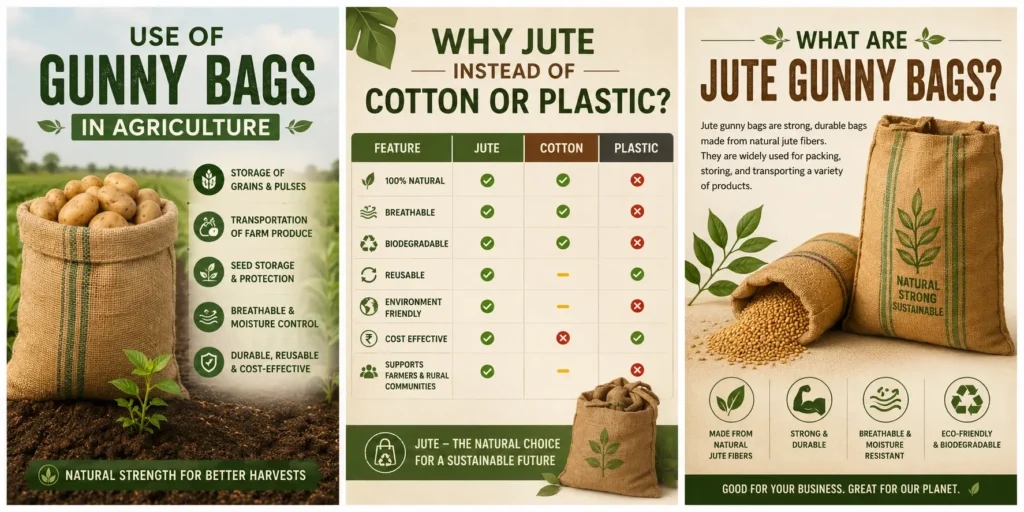
Jute vs. Plastic Gunny Bags
Plastic (polypropylene) gunny bags have grown popular for being lightweight and waterproof, but they come with trade-offs:
| Factor | Jute Gunny Bags | Plastic Gunny Bags |
|---|---|---|
| Biodegradability | Fully biodegradable | Takes centuries to decompose |
| Breathability | High — reduces grain sweating | Low — can trap moisture |
| Cost at scale | Competitive, government-subsidized in some states | Often cheaper upfront |
| Regulatory preference | Mandated for foodgrain packaging under the Jute Packaging Materials Act | No mandate; increasingly restricted |
| Reusability | Reusable, repairable | Reusable but not repairable easily |
India’s Jute Packaging Materials (Compulsory Use in Packing Commodities) Act, 1987 requires a percentage of foodgrains and sugar to be packed in jute material, which is a major reason jute gunny bags remain in steady institutional demand alongside consumer and export demand.
Use of Gunny Bags in Agriculture
Jute gunny bags play a central role across the agricultural supply chain:
- Harvest storage — Farmers pack freshly harvested grain into gunny bags for on-farm storage, protecting it from pests and moisture better than plastic while it awaits transport.
- Transport — Their strength allows safe stacking and handling during transport to mandis (wholesale markets) and warehouses without significant spillage or tearing.
- Government procurement — Agencies like the Food Corporation of India (FCI) use jute bags extensively for procurement and public distribution of foodgrains, partly due to the mandatory jute packaging norms.
- Export packaging — Jute’s natural, food-safe properties make it a preferred packaging material for export-grade produce, coffee, and spices where sustainability certifications matter.
- Soil and erosion control — Beyond storage, gunny bags are repurposed in agriculture for sandbagging, soil erosion control, and nursery bed protection.
Jute Gunny Bags in Mumbai and Delhi: What Buyers Should Know
Both Mumbai and Delhi are major trading and distribution hubs for jute gunny bags, but they serve slightly different markets.
Mumbai functions as a key port and industrial city, so jute gunny bag demand here comes heavily from export-oriented businesses, the textile and commodity trading sector, and warehousing operations serving Maharashtra’s agricultural belt. Buyers in Mumbai often look for suppliers who can handle bulk export documentation and consistent quality certification (like ISO or jute-specific BIS standards).
Delhi, as a major inland trading and distribution center, sees demand driven by wholesale grain markets (mandis), the packaging industry, and businesses supplying government procurement agencies. Because Delhi is closer to jute-producing states via rail freight, buyers here often benefit from shorter supply chains and more competitive wholesale pricing.
If you’re sourcing locally in either city, it’s worth requesting:
- Sample bags before bulk orders
- GST-compliant invoicing
- Clarity on GSM (grams per square meter) — heavier GSM generally means a sturdier bag
- Bulk/wholesale pricing tiers for repeat orders
Jute Gunny Bags Pricing: What Affects the Cost
Pricing for jute gunny bags — including common sizes like the 50 kg jute bag — varies based on several factors rather than a single fixed rate:
- Raw jute prices, which fluctuate seasonally based on crop yield and government-set Minimum Support Prices (MSP)
- GSM/weight of the woven fabric — heavier bags cost more but last longer
- Bag dimensions and load capacity (25 kg, 50 kg, and 100 kg are common)
- Finishing — hemmed edges, printing/branding, and liners (for moisture resistance) add to cost
- Order volume — wholesale and bulk orders typically bring per-unit costs down significantly
- Transport and location — proximity to jute mills in eastern India affects freight costs
Because raw jute prices move with market conditions, it’s best to request current quotes directly from manufacturers or wholesalers rather than relying on a fixed number — a price that was accurate last season may not hold today.
How to Choose the Best Jute Bag Manufacturer in India
With hundreds of jute mills and traders across India, here’s what separates a reliable manufacturer from the rest:
- Check certifications — Look for BIS certification, ISO quality management certification, and compliance with the Jute Packaging Materials Act where applicable.
- Ask about mill vs. trader — Buying directly from a jute mill (common in West Bengal, Bihar, and Andhra Pradesh) often means better pricing and quality control than going through multiple intermediaries.
- Request physical samples — GSM, weave tightness, and stitching quality vary significantly between suppliers; a sample tells you more than a spec sheet.
- Evaluate their export track record — If you need export-grade packaging, ask for past shipping documentation or client references.
- Compare wholesale pricing structures — Reliable suppliers are transparent about how pricing scales with order volume and bag specifications.
- Check customization capability — Many buyers need branded, printed, or specific-sized bags; confirm the manufacturer can handle this in-house.
There isn’t a single universally “best” manufacturer — the right one depends on your order volume, location, and whether you need standard or export-grade packaging. Requesting quotes and samples from two or three verified suppliers before committing is the most reliable way to compare.
Frequently Asked Questions
Why are gunny bags made of jute rather than cotton?
Jute fiber is coarser and stronger than cotton, making it better suited to the abrasion and heavy loads involved in storing and transporting bulk goods like grain. Jute is also cheaper to produce at scale in India and more breathable, which helps prevent moisture damage during storage.
What is the use of gunny bags in agricultural products?
Gunny bags are used to store, transport, and protect harvested grains, pulses, sugar, and produce from farm to market. Their breathable weave reduces moisture buildup and spoilage, and their strength allows safe stacking and handling throughout the supply chain, including in government procurement and export packaging.
Which is the best jute bag manufacturer in India?
There’s no single “best” manufacturer for every buyer — it depends on your order size, required GSM/quality, and whether you need domestic or export-grade bags. The most reliable approach is to shortlist BIS/ISO-certified manufacturers or mills, request samples, and compare wholesale pricing before placing a bulk order.
Which is the best jute bags manufacturer company?
As with individual buyers, “best” depends on your specific needs — location, volume, customization, and certification requirements all matter. Prioritize manufacturers with verifiable certifications, transparent pricing, and a track record of consistent quality over marketing claims alone.
Final Thoughts
Jute gunny bags aren’t a legacy product hanging on out of habit — they remain in active, growing demand because they solve real problems: they’re strong, breathable, biodegradable, and backed by regulatory preference in India’s agricultural supply chain. Whether you’re a farmer, a wholesaler in Delhi or Mumbai, or a business exploring sustainable packaging, understanding what drives quality and pricing will help you make a better sourcing decision than going with the first supplier you find.
This guide is intended as general informational content. For current pricing, certifications, and product specifications, verify directly with manufacturers, as jute market conditions change seasonally.